
Cost guide
What drives the cost of a renovation.
A renovation is priced by what you remove and what you put back, and by what the house turns out to be made of once the linings come off. This guide explains the factors that move a renovation budget, what you control, and the mistakes that cost the most. No figures: your own estimate is free.
Removing, finding, replacing
A new home starts from nothing. A renovation starts from a house, and three things about that house set the budget before a single product is chosen.
The first is what you keep and what you strip out. A renovation that leaves the structure, the roof and the services alone and changes the finishes is a very different job from one that moves walls, relocates a kitchen or opens the house to the garden. Every wall that moves is demolition, a beam, patching and making good; every kitchen or bathroom that changes rooms is new plumbing and drainage runs through floors and walls that were never meant to carry them. Keeping things where they are is the single biggest saving in most renovations.
The second is what you find. Behind old linings sit the real condition of the frame, the state of the wiring and the plumbing, whether the floor is level, and, in older houses, materials that need licensed removal. None of it is visible from the room, and all of it must be dealt with before the new finishes go on. This is why renovation budgets carry a contingency and why the estimate shows it as its own line rather than hiding it in the rates.
The third is the age and construction of the house. Double brick, brick veneer, weatherboard on a timber frame and a fibro cottage each strip and rebuild differently. Period details worth keeping, from cornices to sash windows, cost more to restore than to replace, and some trades are specialists.
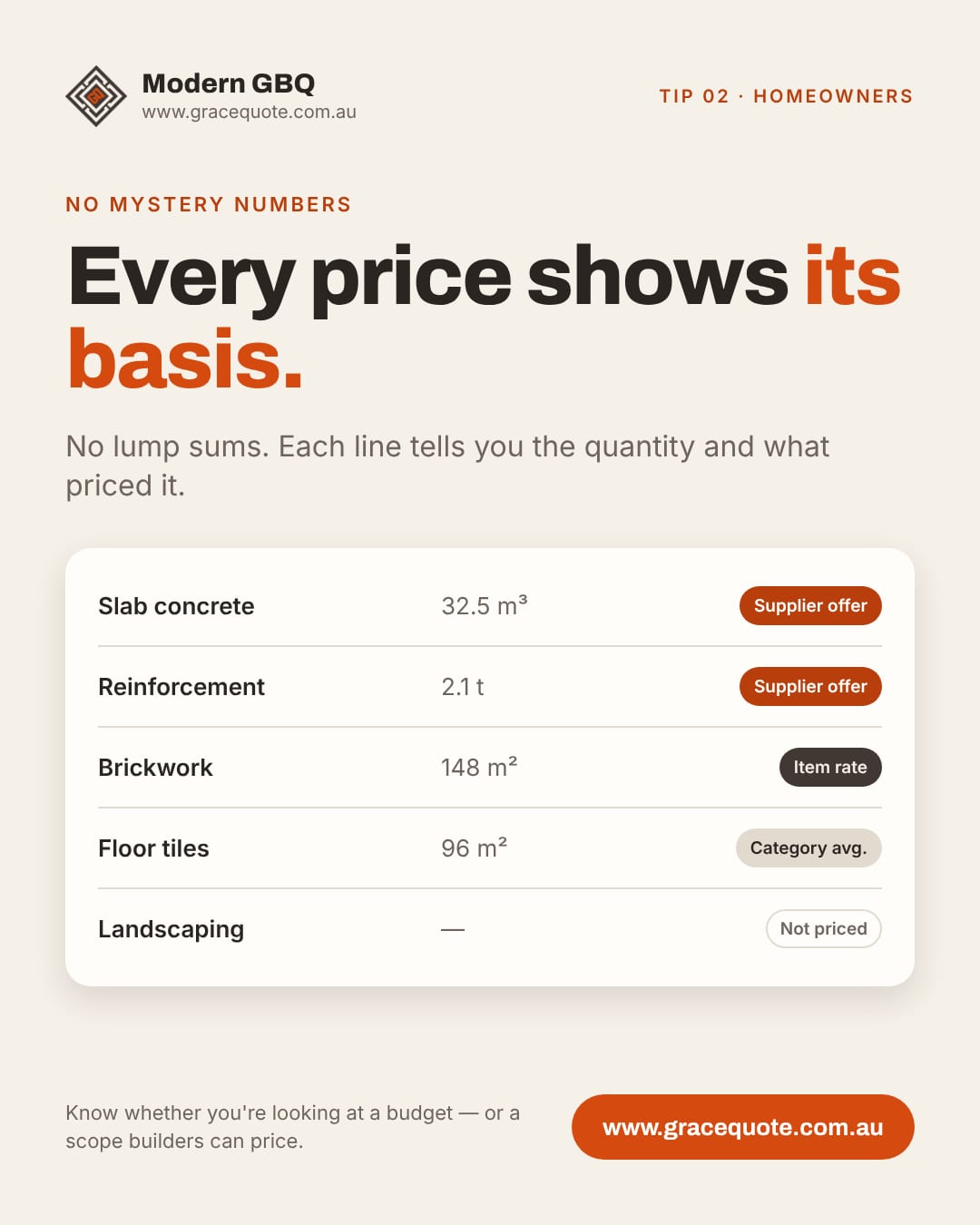
Then the renovation is priced like any building work, quantities first: square metres of floor and wall finish removed and replaced, metres of skirting and cornice, numbers of doors and windows, points of plumbing and electrical. Each quantity gets its price from a supplier offer, a market price or a rate, plus the trade hours to install it.
The rooms that cost most are the ones that are full of services. A kitchen or bathroom renovation packs demolition, plumbing, electrical, waterproofing, tiling, cabinetry and appliances into a few square metres. A living room is mostly floor, paint and perhaps a window. Finally, the finish level runs across everything you can see, and for a renovation that includes the temptation to refresh the rooms next to the ones you planned.
The cost factors, and what you control
| Factor | Why it moves the price | What you control |
|---|---|---|
| Keep or move | Moving walls, kitchens and bathrooms adds demolition, beams, new service runs and making good | A plan that keeps the wet rooms where they are |
| Condition of the house | The frame, wiring, plumbing and floors are only known once the linings come off | An inspection first; a contingency shown as its own line |
| Construction type | Double brick, brick veneer, weatherboard and fibro strip and rebuild differently | Not much, beyond knowing what you have |
| Period details | Restoring cornices, sash windows and floors costs more than replacing them | What you restore and what you replace |
| Wet rooms | Kitchens and bathrooms concentrate waterproofing, tiling, plumbing, electrical and cabinetry | How many you touch, and whether they move |
| Services | Rewiring, re-plumbing or a new switchboard are often triggered by the work, not chosen | Finding out before you design |
| Openings | A new window or a wall opened to the garden means a beam and a priced product | Number and size of new openings |
| Finish level | Runs across every surface and fitting you replace | Economical, Standard, Good or Advanced, then product by product |
| Living through it | Staging the work around a family in the house costs time; moving out costs rent | The sequence, and where you live |
Finish levels explained
On Modern GBQ a finish level, Economical, Standard, Good or Advanced, sets a default product on every line that needs one: flooring, wall and ceiling finishes, tiles, cabinetry and benchtops, tapware and sanitaryware, doors, hardware and lighting. Economical is the plainest listed product that does the job; Standard the mid-range most homes are finished with; Good a step up in material and brand; Advanced premium products and the extra labour some of them need.
Renovations are where the finish level is most tempting to push, because finishes are most of what a renovation is. The discipline is to decide which rooms the money is for. A Good bathroom and a Standard everything else is a common and sensible answer; Advanced across the house is a different budget.
Every default can be swapped for a listed alternative with a photo and a reason, and re-priced as a new version, so the choice is never final until a builder prices it. The level does not change what you find behind the walls.
Common mistakes
- Budgeting only for what you can see. The frame, wiring, plumbing and floor behind the finishes are where renovations overrun. Inspect first and carry a contingency on its own line.
- Moving the kitchen or bathroom without a reason. New drainage and water runs through an existing house are among the dearest lines in a renovation.
- Starting with the finishes. Choose the layout and settle the structure and services before tiles and tapware; otherwise the finishes are chosen twice.
- Renovating room by room with no plan. Each room priced on its own repeats the set-up, the trades and the disruption. One scope, staged, is cheaper than five small jobs.
- Ignoring licensed work. Some materials in older houses need licensed removal, and all electrical and plumbing work does. Allow for it.
- Comparing builders on different scopes. Approve one scope and have every builder price that, so the lowest quote is not the one that left the rewiring out.
- Treating the estimate as a quote. It is an estimate for budgeting; the quote comes from the builder on the approved scope, and what they find behind the linings is a variation to agree with them directly.
Your own figure
Get a free ballpark for your renovation.
Suburb, the floor area you are renovating, project type and finish level. We email you a link that opens your free account with the project already filled in.
Renovation questions.
Can an estimate know what is behind my walls?
No, and it does not pretend to. It prices the work you describe and shows a contingency as its own line. An inspection before you design is the best money a renovation spends.
Should I renovate or extend?
Renovating keeps the footprint and changes what is inside it; extending adds rooms and the join to the old house. Price both as versions on the same project and compare them side by side.
Does the estimate include demolition?
Work you add to the scope as quantities is priced with the trade hours to do it. Anything not in the scope is listed under what is not in the price, so nothing is silently assumed.
Can I do part of the work myself?
The estimate shows the labour hours and trade rate on every line, so you can see what a trade would charge for the parts you take on. Electrical, plumbing and some removal work must be done by licensed trades.
Price the renovation before you meet a builder.
Free to start. Every line explained.